

When Was Air Conditioning Invented?
In the sweltering heat of a Florida summer, it can be easy to take air conditioning for granted — until it stops working. Today, nearly 90% of Americans use air conditioning, and the modern systems we use can largely be traced back to Willis Carrier. While he was not the first to experiment with cooling technology, Carrier is widely credited as the engineer who invented air conditioning as we know it today. From ancient innovations to industrial breakthroughs, the history of air conditioning spans centuries and continents, and the technology in our homes today has a fascinating past.
Early Cooling Innovations
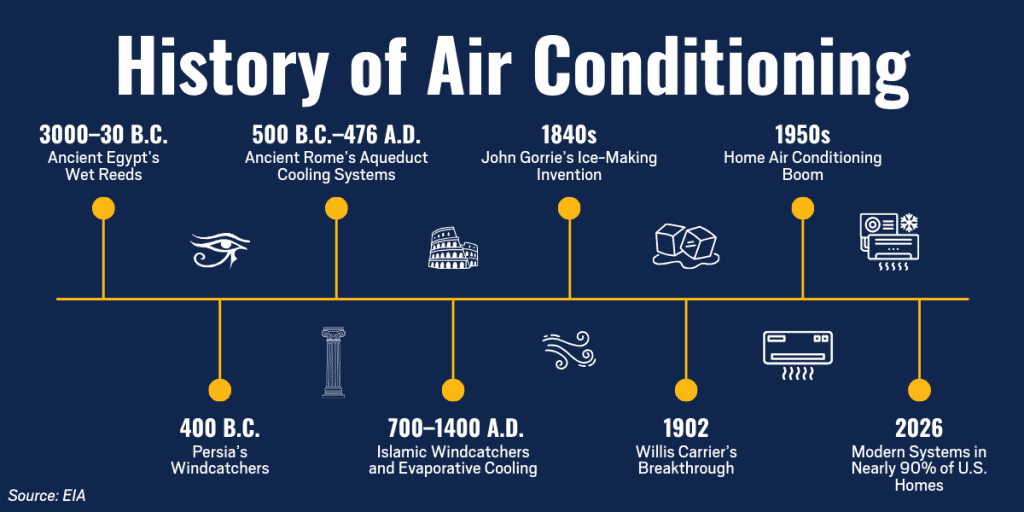
Long before Carrier invented modern air conditioning, people across the world sought ways to cool their living spaces. In ancient Egypt, homes were often cooled using wet reeds hung in windows, allowing breezes to pass through and lower indoor temperatures through evaporation. In Persia, early engineers developed windcatchers, which were tall structures designed to funnel cool air down into buildings while pushing hot air out.
In ancient Rome, many wealthy members of society used aqueduct systems to circulate cool water through the walls of their homes, effectively lowering indoor temperatures. These early cooling methods, while innovative, were largely limited to those with wealth and resources. It would be centuries before cooling technology evolved beyond passive systems and became accessible to the broader population.
Following the fall of the Roman Empire, advances in cooling technology continued outside of Europe. In the Islamic world, engineers refined Persian windcatchers and evaporative cooling techniques, using architecture and water to naturally regulate indoor temperatures for centuries.
In the mid-1800s, Florida physician Dr. John Gorrie laid important groundwork for modern air conditioning. Gorrie believed artificial cooling was essential to improving comfort and care for hospital patients, particularly those suffering from illnesses worsened by heat. With that goal in mind, he began developing technology designed to cool indoor air.
Despite his innovative ideas, Gorrie faced significant challenges. Technical limitations and the loss of financial support prevented his designs from being widely adopted during his lifetime. However, historians credit him with inventing an ice-making machine, which was patented in 1851 and marked a critical step toward the mechanical cooling systems that would follow.
The First Patent for Air Conditioning
More than half a century later, many people around the globe were still searching for a solution that could provide relief from excessive heat. In 1902, Brooklyn’s Sackett-Wilhelms Lithographic and Publishing Company ran into a major problem. During the warmer months, extreme heat and humidity interfered with their work, causing printed pages to swell and ink to blur, often ruining entire print runs.
Frustrated, the company turned to a 25-year-old engineer named Willis Carrier to find a solution that could cool the building and improve printing conditions. Through a series of experiments, he developed a system that pushed air over coils filled with cold water. With the help of a large industrial fan, excess humidity condensed on the coils, cooling and stabilizing the air inside. By solving the publisher’s problem, Carrier laid the foundation for air conditioning as we know it today.
Carrier’s Breakthrough: The “Apparatus for Treating Air”
Carrier did not stop at solving one company’s problem. In September 1904, he applied for a patent on his invention, which he described as an “Apparatus for Treating Air.” The design later became patent No. 808,897, issued on January 2, 1906. What set Carrier’s creation apart was its ability to both filter and control the humidity of air, either adding or removing moisture as needed.
This air conditioning equipment became an essential building block for modern air conditioning. Carrier’s innovative thinking not only kept printing presses running smoothly but also paved the way for the cool, comfortable indoor environments people rely on today.

Refining the Design
Carrier quickly realized that artificial cooling was not just helpful for the printing industry but could benefit many others as well. His system proved valuable for manufacturers of leather goods, food products and other materials sensitive to temperature and humidity. As a result, Carrier became a passionate advocate for his invention, widely sharing the potential of this new technology. By 1922, he had refined his design into a smaller, safer and more powerful version he called the centrifugal refrigeration compressor.
Before air conditioning became common in homes, many people experienced it instead in movie theaters, which in the 1920s were often small, crowded and uncomfortably hot. Installing air conditioning was both a novelty and a luxury that made the moviegoing experience far more enjoyable, leading to its widespread adoption in theaters across the United States.
Theaters were only the beginning, and by the late 1920s, air conditioning had expanded into retail shops and other commercial spaces as well. Smaller units were introduced to cool everything from egg storage rooms to department stores, helping businesses protect perishables while keeping customers comfortable. Window-sized models soon followed, appearing in banks, office buildings and even the U.S. Supreme Court.
These steady advances in design and accessibility paved the way for air conditioning to become part of everyday life, long before it found a permanent place in the average American home.
Home Gets Cool
Several decades after Carrier first invented air conditioning, continued improvements made the technology smaller, more efficient and suitable for residential use. Split-system units, which separate indoor and outdoor components, developed by Frigidaire used refrigerator-based technology to reduce the size of the equipment enough for home installation. General Electric soon followed with additional innovations that made residential air conditioning even more compact and practical.
By the 1950s, window air conditioning units were being widely marketed to American households as an affordable postwar luxury. Around the same time, air conditioning also began appearing in automobiles, with factory-installed car air conditioning becoming more common by the late 1950s and early 1960s. While not yet universal, climate-controlled cars reinforced the idea that comfort could travel beyond public buildings and into everyday life.
As the technology advanced, central air conditioning systems gained popularity, and by the late 1960s, most U.S. homes had some form of air conditioning, changing how people thought about comfort, home design and daily life.
Today, nearly 100 million U.S. homes are equipped with air conditioning, thanks to Carrier and the innovative minds who came before and after him. Modern HVAC systems provide benefits beyond temperature control, including improved air quality, humidity regulation and air filtration.
Trust the Experts
Like HVAC companies around the world, Barineau Heating and Air Conditioning is a proud and award-winning Carrier authorized dealer, continuing a legacy of comfort that began more than a century ago. The professionals of Barineau have been proudly serving north Florida, south Georgia and the Emerald Coast areas for more than 50 years and three generations with top-quality home comfort service. Through committed hard work, integrity, ingenuity and treating customers like family, Barineau has built a reputation as the premier HVAC service company in the area.
With Barineau Heating and Air Conditioning’s Total Comfort Service Program, you’ll enjoy cost-saving benefits like no overtime charges and repair discounts. Signing up for an annual plan removes the burden of having to remember annual maintenance appointments, and you will receive priority service whenever you need us. You can rest easy knowing that Barineau has your back and will remind you when it’s time for your appointment.
Have questions? Call our team at (850) 580-4029 or schedule an appointment.